The Clermont Lantern
News & features bringing light to Clermont County, Ohio

Kira Jordan
Queer Birders hosted winter event at Pattison Park Lodge
Lady Gaga’s hit song “Born This Way” played over the speakers on a cold winter morning inside the Pattison Park Lodge as an enthusiastic Ash Conway greeted them.
Conway founded Queer Birders of Cincinnati in 2021 with the goal of getting LGBTQ+ people outdoors and educated about the various birds a person could see traveling through Hamilton County.
In February, Queer Birders partnered with the Clermont Park District to host an educational event about community apps like eBird, iNaturalist and Merlin Bird ID that can assist bird watchers. Attendees were dressed for the weather so they could participate in a hike after the classroom portion of the day, where they would test their newfound knowledge.
The lodge was set up with four rows of five chairs facing a projector screen. On two tables near the entrance, bird specimens were laid out neatly for examination. This was the Queer Birder’s table. The other table was for the park district and contained brochures which told readers about the various programs and events Clermont Park District hosts. Nearby, a hot chocolate bar offered extra warmth for anyone who needed it.

The event focused on community science. Community science exists with the aim of bridging the gap between researchers and the public by allowing the public to contribute to real scientific data. The event organizers talked about the Great Backyard Bird Count, which is a yearly global community science initiative that encourages participants to submit bird sightings through platforms like eBird or Merlin.
The first in-depth presentation delved into iNaturalist. iNaturalist is one of the largest community science apps with the goal of linking observations to scientists. Flora and fauna are identifiable on the app through the app's AI photo identification tool, and scientists and community users can review posts on “observations” to judge the accuracy of the AI identification or the user's own identification.
One audience member confirmed that iNaturalist is used by scientists because they themselves used iNaturalist data in their master’s thesis. Clermont Park District runs its own iNaturalist project called “Flora and Fauna of CCPD,” which has already documented over 900 observations featuring nearly 500 species from just 17 observers since January of 2025. District representatives noted that iNaturalist has helped identify missing plant species, shifted understanding of species’ ranges, and even changed conservation status designations.
The presenters then demonstrated the Merlin Bird ID app followed by a discussion of eBird. Attendees learned about the sound identification feature on Merlin which allows users to use their phone microphone to gather live information about the birds sounding off around them. Merlin also has a photo identification feature which Ash warned was not the best working at the moment and that users would get the best results with side views of birds. eBird was described as a digital scrapbook of all the birds a person has seen and where they saw them.
Before heading outside, Cae Skiff from the Clermont Park District highlighted an important issue in community science: 69% of observations made on community science apps come from green spaces. The total amount of land in the United States that is designated as green space is only 11%. Participants were encouraged to make and log observations made outside of green spaces, instead they should try to gather data from their communities and urban environments.
An attendee named Heather had heard about the event through the Queer Birders GroupMe and had driven half an hour to participate in the event. This was their third Queer Birders event, and their first in Clermont County. “The drive was picturesque,” Heather said, noting how much they enjoyed seeing the woods on the way in. “This place reminds me of my hometown in Indiana.”
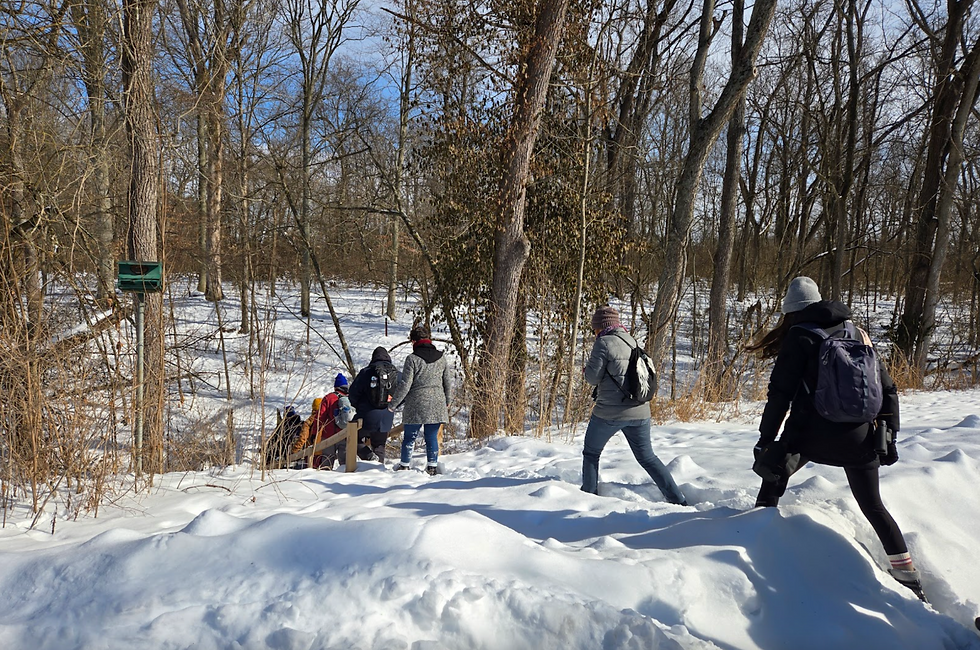
After the presentation, the group hiked outside, navigating a snowy staircase down a hill, through some woods, through an open field, and over a boardwalk. In the open field, Cae checked a nest box for signs of sugar gliders, which seek shelter in there during the winter.

A pair of turkey vultures flew overhead, which drew excited whispers and binocular use. As the group walked, conversations flowed between facts about migratory birds to plant and tree identification, including the “anachronistic” adaptations of the thorny honey locust tree.
The event concluded with participants expressing gratitude for the event organizers, and one attendee even expressed their appreciation to the birds for providing the group company during the hike.